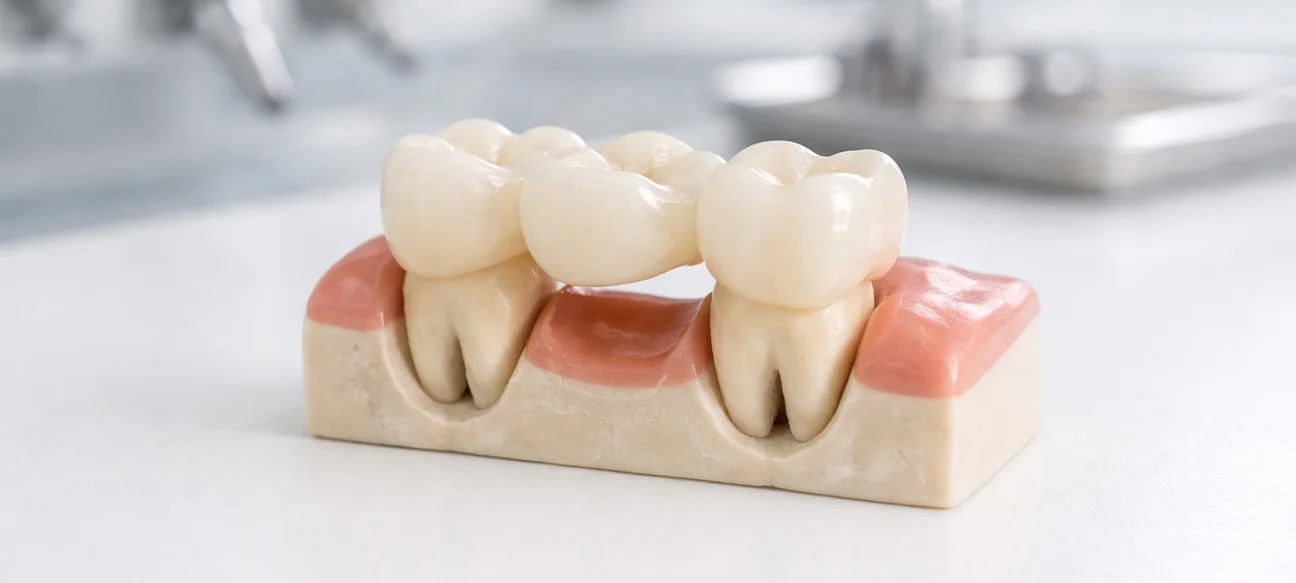
Dental Bridges in Sacramento, CA
Dental bridges are restorative appliances that are used to replace one or more missing teeth by filling spaces within the dental arch. At Jeff L. DiMariano, DDS, bridge treatment is available for patients seeking a fixed replacement option for tooth loss. A bridge includes one or several artificial teeth that are secured using neighboring teeth or dental implants, depending on the treatment design.
Replacing missing teeth is important because gaps may affect chewing, speech, bite balance, and the positioning of surrounding teeth. At a trusted dentist in Sacramento, bridge restorations are commonly used to restore continuity within the mouth while supporting everyday oral function.
Types of Dental Bridges Near You
Several bridge designs may be considered depending on the number of missing teeth and the condition of surrounding structures.
Traditional Dental Bridges: This design uses crowns placed on neighboring teeth to support one or multiple replacement teeth positioned within the gap.
Cantilever Dental Bridges: Cantilever bridges are sometimes used when only one neighboring tooth is available to provide support for the restoration.
Maryland (Resin-Bonded) Dental Bridges: Maryland bridges utilize a framework attached to the back surfaces of adjacent teeth, reducing the need for full-coverage crowns in certain situations.
Implant-Supported Dental Bridges: When several teeth are missing in sequence, dental implants may be used to support the bridge instead of relying solely on natural teeth.
When Dental Bridges May Be Recommended
Bridge treatment may be considered when missing teeth create spaces that interfere with chewing, speech, or bite stability. Many patients researching dental bridges in Sacramento want to understand whether a bridge can replace missing teeth without placing an implant for every lost tooth.
The most appropriate treatment approach depends on several factors such as the number of missing teeth, the location of the gap, bone support, and the condition of neighboring teeth. A comprehensive evaluation helps determine which bridge design may be suitable for the specific clinical situation.
Dental Bridges And Everyday Oral Function
Missing teeth can influence several aspects of oral function. Changes in chewing efficiency, speech patterns, and bite distribution may occur when spaces remain untreated for extended periods.
Bridge restorations help replace missing teeth and support balanced function throughout the dental arch. Modern materials are selected to resemble surrounding teeth while helping maintain normal oral performance during daily activities. Treatment recommendations are based on the condition of existing teeth, supporting structures, and overall oral health findings.
Benefits of Dental Bridges
Bridge restorations may provide several functional and restorative advantages.
Gap Replacement: Dental bridges fill spaces created by missing teeth and help maintain continuity within the dental arch.
Chewing Support: Replacing missing teeth can help improve the distribution of biting forces during eating.
Tooth Position Maintenance: Bridges help reduce the likelihood of neighboring teeth drifting into unoccupied spaces.
Restorative Support: Replacing missing teeth may assist in maintaining bite relationships and overall oral stability.
Long-Term Serviceability: With routine maintenance and professional monitoring, bridges may remain functional for many years.
Personalized Planning For Tooth Replacement
Selecting a tooth replacement option involves reviewing several clinical considerations, including the number of teeth being replaced, bite function, oral health status, and long-term maintenance requirements.
Many individuals comparing dental bridges near you also review alternative restorative options before making treatment decisions. At Jeff L. DiMariano, DDS, treatment discussions focus on identifying an approach that addresses the specific restorative findings present during examination. Our Sacramento office serves patients from surrounding communities including Arden Fair, Midtown, Arden-Arcade, Cal Expo, and Bushy Lake.
Frequently Asked Questions
The lifespan of a bridge depends on oral hygiene practices, bite forces, supporting teeth or implants, and routine dental maintenance. Regular examinations allow the restoration to be evaluated over time.
Yes. Depending on the clinical situation, bridges may be designed to replace several adjacent missing teeth using appropriate support structures.
A bridge replaces missing teeth by using neighboring teeth or implants for support, whereas an implant replaces an individual tooth root. The most appropriate choice depends on oral health findings, bone support, and treatment objectives.
Modern bridge materials are selected to resemble surrounding teeth in shape, size, and color, helping the restoration blend with adjacent dentition.
A dental bridge replaces one or more missing teeth by anchoring a replacement tooth, or several, to the natural teeth or implants on either side of the gap. It restores your bite, prevents shifting teeth, and fills in your smile.
With good oral hygiene and regular checkups, a well-made bridge can last 10 to 15 years or longer. The teeth supporting it need to stay healthy, which is why we keep an eye on those anchor teeth at every visit.
The procedure itself is done under local anesthesia, so you shouldn't feel pain during placement. Some mild sensitivity around the supporting teeth is common for a few days afterward, but it typically resolves quickly.
A bridge relies on neighboring teeth for support, while an implant is anchored directly into the jawbone and stands on its own. Bridges generally take less time and fewer appointments, while implants tend to preserve jawbone density better over the long run. We'll help you weigh which fits your situation.
Yes, once it's fully placed and you've adjusted to it, a bridge functions much like your natural teeth. We do recommend being a bit cautious with very hard or sticky foods to protect the restoration long-term.
You'll brush it like your natural teeth, but the area underneath the bridge needs special attention since regular floss can't reach it. We'll show you how to use a floss threader or water flosser so that space stays clean and gum-healthy.
Bridges are commonly made from porcelain, porcelain fused to metal, or zirconia, depending on the location in your mouth and how much bite force the area handles. We choose the material based on durability and how natural it will look.
Most bridges take two main visits: one to prepare the supporting teeth and take impressions, and a second to fit and cement the finished bridge. We'll confirm the exact timeline once we've evaluated your specific case.
Yes. If a bridge becomes loose, damaged, or worn over time, it can usually be replaced, and the supporting teeth can often be reused if they're still healthy. We'll check the condition of those anchor teeth before recommending next steps.
For a single missing tooth, a bridge is often one of the most efficient solutions, especially when the neighboring teeth could use crowns anyway. We'll compare it against an implant for your specific gap so you can choose what works best long term.
Contact Us Today!
If you would like to learn more about bridge treatment or discuss available tooth replacement options, contact Jeff L. DiMariano, DDS in Sacramento, CA. Our team can evaluate your restorative needs, review possible treatment approaches, and determine whether a dental bridge may be appropriate for your situation.